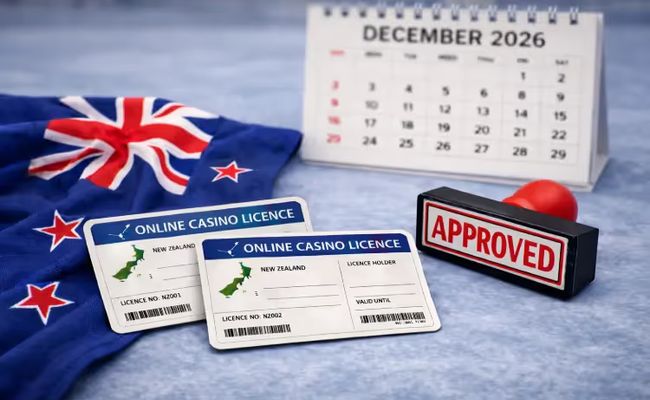
New Zealand has formally set its transition from an unregulated offshore online casino market to a fully licensed domestic regime, confirming that online casino licences will begin to be issued from 1 December 2026. The regulated market is now expected to become fully operational on 1 January 2027, following legislative delays linked to the finalisation of community funding arrangements.
The announcement provides long-awaited clarity for operators, regulators, and community stakeholders, marking a significant shift in how online gambling will be supervised in New Zealand. For players, the new framework is intended to apply consistent rules to online casinos that accept players from New Zealand, with a stronger focus on compliance and harm prevention.
Licensing Timeline Now Locked In
Under the current framework, the licensing process will open on 1 December 2026. This positions the country for a clean transition into a regulated market at the start of 2027, allowing time for operators to complete compliance checks, platform approvals, and consumer protection requirements.
The revised timeline reflects delays earlier in the legislative process, primarily due to disagreements over how online casino revenue will contribute to community and harm-prevention funding.
Limited Licence Structure And Auction Process
The New Zealand government has confirmed that only 15 online casino licences will be made available. These licences will be awarded through a competitive auction process expected to take place in mid-2026.
Each licence will be valid for an initial three-year period, with the option to renew for up to a further five years. The model is designed to tightly control market entry, limit oversaturation, and ensure that licensed operators meet high regulatory and financial standards.
The regime will permit only casino-style gambling products. Operators will be restricted in the number of licences they can hold, reinforcing the government’s intention to avoid market concentration.
Taxation, Levies, And The Community Funding Model
Licensed operators will be subject to a layered tax and levy structure. This includes a 12 percent offshore gambling duty, a 1.24 percent levy dedicated to gambling harm prevention, and a newly confirmed 4 percent community funding tax.
The additional community contribution is intended to support grassroots sports, charities, and local initiatives. Government estimates suggest the new funding mechanism could generate between NZ$10 million and NZ$20 million in the first year of the regulated market, depending on overall gambling revenue.
Unlike New Zealand’s not-for-profit Class 4 gaming model, the online casino framework mirrors the contribution structure used by for-profit land-based casinos, reflecting the commercial nature of licensed online operators.
Regulations Expected By Mid-2026
Detailed regulations governing the new regime are expected to be finalised by mid-2026. These rules will cover consumer protection standards, harm-minimisation measures, advertising and marketing restrictions, data retention requirements, and compliance reporting.
Finalising the regulations well ahead of the licence auction is intended to give potential applicants sufficient time to assess compliance costs and operational requirements before bidding.
Industry Interest From Major Operators
Several major gambling operators have already signalled interest in applying for one of the 15 licences. These include domestic incumbents such as SkyCity and TAB NZ, as well as international operators such as bet365 and 888 Casino &Sportsbook.
The limited number of licences is expected to drive strong competition, particularly from established operators with existing compliance frameworks in other regulated jurisdictions.
Ongoing Concern From Sports And Community Groups
Despite the confirmed funding mechanism, the legislation continues to face resistance from parts of the sporting sector. Many regional sports organisations remain concerned that changes to gambling flows could reduce the funding they currently receive from land-based gaming machines.
Community groups argue that online casinos may not replace the scale or consistency of existing grants tied to physical pokie venues, potentially impacting grassroots sport and local facilities.
Government Position And Next Steps
The government maintains that regulation is necessary to bring offshore gambling activity under local oversight, reduce player harm, and ensure tax revenue remains within New Zealand. The framework has been positioned as a consumer-protection measure as much as a fiscal reform.
Oversight of the reform process sits with the Department of Internal Affairs under the direction of Brooke van Velden. Parliamentary scrutiny is ongoing, with select committee hearings scheduled to continue into 2026 as the final regulatory settings are refined.
With the licensing date now fixed and the framework largely defined, New Zealand’s online casino sector has entered its final preparatory phase ahead of one of the most significant gambling reforms in the country’s modern history.
Share your thoughts in the comments
No comments yet. Be the first to comment!